In the past weeks, we have studied two systems that appear very different, but where topology showed up in a very similar way.
First, let’s consider the quantum spin-Hall insulator. As we saw two weeks ago, it is characterized by a fermion parity pump: if you take a Corbino disk made out of a quantum spin-Hall insulator and change the flux by half a normal flux quantum, that is by \(h/2e\), one unit of fermion parity is transferred from one edge of the sample to the other.
Secondly, let us consider a one-dimensional topological superconductor, like we studied in weeks two and three. If such a system is closed into a Josephson ring, and the flux through the ring is advanced by one superconducting flux quantum \(h/2e\), the fermion parity at the Josephson junction connecting the two ends changes from even to odd, or viceversa. This is the \(4π\) Josephson effect, one of the main signatures of topological superconductivity.
Note that the change in flux is equal to \(h/2e\) in both cases, since a superconducting flux quantum \(h/2e\) is half of the normal flux quantum \(h/e\).
This suggest that once you have a quantum-spin Hall insulator, you are only one small step away from topological superconductivity and Majoranas. The only ingredient that is missing is to introduce superconducting pairing on the quantum spin-Hall edge.
But this is easy to add, for instance by putting a superconductor on top of the outer edge of our quantum spin-Hall Corbino disk:
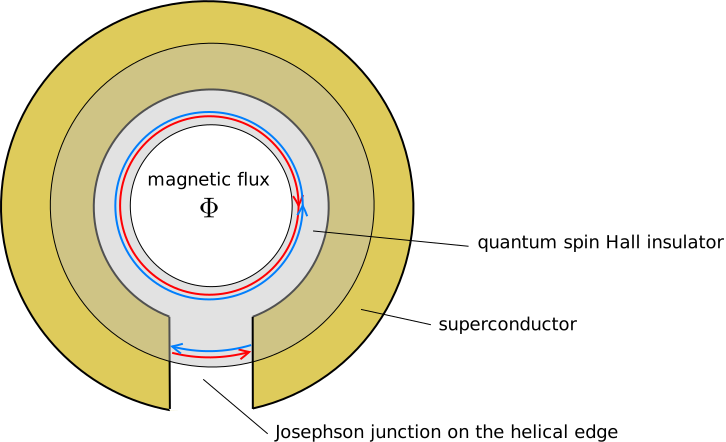
The superconductor covers the entire quantum spin-Hall edge except for a small segment, which acts as a Josephson junction with a phase difference given by \(\phi = 2e\Phi/\hbar\), where \(\Phi\) is the magnetic flux through the center of the disk. We imagine that the superconductor gaps out the helical edge by proximity, which means that Cooper pairs can tunnel in and out from the superconductor into the edge. In order for this to happen, a conventional \(s\)-wave superconductor is enough.
We will not repeat our pumping experiment, that is increasing the flux \(\Phi\) by \(h/2e\). We know that one unit of fermion parity must be transferred from the inner edge of the disk to the outer edge. However, the only place where we can now find a zero-energy state is the Josephson junction, because the rest of the edge is gapped.
From the point of view of the superconducting junction, this means that advancing the phase difference \(\phi\) by \(2\pi\), the ground state fermion parity of the junction changes. Recalling what we learned in the second and third weeks, we can say that the Josephson effect is \(4\pi\)-periodic.
Majoranas on the quantum spin-Hall edge
We know that the \(4\pi\)-periodicity of the Josephson effect can always be associated with the presence of Majorana zero modes at the two superconducting interfaces of the Josephson junction.
However, if you compare the system above with the Josephson ring studied in week three, you will notice an important difference. In that case, the Josephson junction was formed by an insulating barrier. Now on the other hand, the two superconducting interfaces are connected by the quantum spin-Hall edge.
This means that our Majoranas are connected by a gapless system, and therefore always strongly coupled. In order to see unpaired Majoranas, or at least weakly coupled ones, we need to gap out the segment of the edge forming the Josephson junction.
To gap it out, we can try to place another superconductor in the gap. Unfortunately, this doesn’t really help us, because it results in the formation of two Josephson junctions connected in series, and we only want one.
However, we know that the edge modes of the quantum spin-Hall insulator are protected from backscattering by time-reversal symmetry. To gap them out, we need to break time-reversal symmetry. Since a magnetic field breaks time-reversal symmetry, we can gap out the edge modes by placing a magnet on the segment of the edge between the two superconductors:
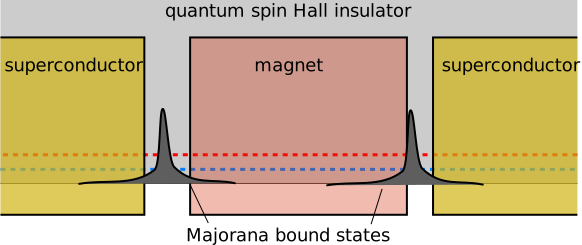
In the sketch above, you see two Majoranas drawn, one at each interface between the magnet and the superconductor. Their wavefunctions decay as we move away from the interfaces. As Carlo Beenakker mentioned in the introductory video, these Majoranas are quite similar to those we found at the ends of quantum wires.
To understand them in more detail, note that the magnet and the superconductor both introduce a gap in the helical edge, but through a completely different physical mechanism. The magnet flips the spin of an incoming electron, or hole, while the superconductor turns an incoming electron with spin up into an outgoing hole with spin down. These two different types of reflection processes combine together to form a Majorana bound state.
We can capture this behavior with the following Bogoliubov-de Gennes Hamiltonian for the edge:
\[H_\textrm{BdG}=(-iv\sigma_x \partial_x-\mu)\tau_z+m(x)\,\sigma_z+\Delta(x)\,\tau_x.\]
The first term is the edge Hamiltonian of the quantum spin-Hall effect, describing spin up and down electrons moving in opposite direction, together with a chemical potential \(\mu\). The matrix \(\tau_z\) acts on the particle-hole degrees of freedom, doubling the normal state Hamiltonian as usual. The second term is the Zeeman term due to the presence of the magnet. Finally, the last term is the superconducting pairing.
The strength of the Zeeman field \(m(x)\) and the pairing \(\Delta(x)\) both depend on position. At a domain wall between the superconductor and the magnet, when the relevant gap for the edge changes between \(m\) and \(\Delta\), the Hamiltonian above yields a Majorana mode.
This is shown below in a numerical simulation of a quantum spin-Hall disk. The left panel shows the edge state of the disk without any superconductor or magnet. In the right panel we cover one half of the disk by a superconductor and the other by a magnet, and obtain two well-separated Majoranas:
