In the previous cases of the Kitaev chain and the quantum Hall effect, the bulk topological invariant that we eventually obtained was characterized by the response to some adiabatic experiment.
Since the time-reversal invariant topological insulator is two dimensional like a quantum Hall system, it is reasonable to put the system in a Corbino geometry and change the flux through the system, creating an azimuthal electric field:
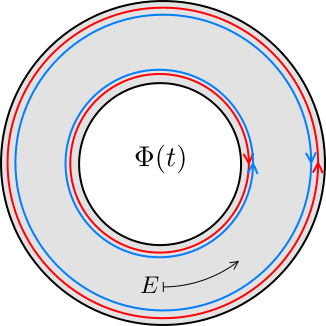
However, because of time-reversal symmetry, the system is forbidden from having a Hall conductance and therefore there cannot be any charge transfer between the two edges of the disk. For instance, if we consider two copies of the Haldane model with opposite spin, there will be two quantum Hall pumps working in opposite directions (one transferring charge from the inner edge to the outer edge, the other one from the outer edge to the inner one). So the net charge transferred is zero.
Because the two pumps act on electrons with opposite spin, you might be tempted to define a spin current, which would flow in response to the electric field, orthogonal to it. However, as we just discussed, the spin along a given direction may not be conserved, so generally this is not a good way to define a robust pumping effect.
To understand what exactly happens in the pumping process, let’s look at the energy spectrum of the edge states for the BHZ model in the cylinder geometry. As we discussed in the quantum Hall lectures, the cylinder geometry is really equivalent to the Corbino disk, except that it is easier to study.
You also learned that in a cylinder of finite circumference \(L\), the momenta of the allowed edge states are quantized at values determined by the flux.
To make things more simple, you may actually imagine that the circumference of the cylinder is just a single unit cell long. We then have only one allowed value of the momentum \(k\) along the edge, which is exactly proportional to the flux threaded through the cylinder, \(k = 2\pi \Phi/\Phi_0\).
So let’s look at the energy spectrum of a cylinder as a function of \(k\) (or equivalently \(\Phi\)), and compare a cylinder in the quantum spin Hall phase with a cylinder in the trivial insulating phase.
In both cases you see that at \(k=0\) there are isolated pairs of states with degenerate energies, between the valence and conduction bands. The Fermi energy is set at \(E=0\), in the middle of the gap between conduction and valence bands. These states are the Kramers pairs at the edges - one pair for the topological case, two for the trivial case. You also see the splitting of Kramers pairs as soon as \(k\) goes away from zero. This is because \(k = 0\) is a time-reversal invariant point, a point in momentum space that is mapped to itself by time-reversal symmetry.
The plot ends at \(k=\pi\) (that is, \(\Phi=h/2e\)), which is another time-reversal invariant point. Indeed, time-reversal symmetry sends \(\Phi\to-\Phi\), but for \(\Phi=h/2e\) this corresponds exactly to adding or subtracting a flux quantum. Hence, all the physical properties of the system remain unchanged under the action of time-reversal for this value of the flux. And indeed you can see that all levels meet again and form Kramers pairs.
We now see an interesting difference though. In the topological case, the Kramers pairs at \(k=\pi\) are not the same as those at \(k=0\). In the trivial case however, the pairs are the same. As a consequence, in the topological case there is an odd number of levels crossing zero-energy, while in the trivial cases there is an even number of them. Therefore changing the flux by \(h/2e\) in the topological case changes the fermion parity at the edge, while it does nothing in the trivial case. We have thus obtained a fermion parity pump.
Strangely, this reminds us of the topological superconducting ring that we studied in the second week of the course. There we also had a fermion parity change in response to a flux. It turns out that this is not a coincidence, as we will see when we discuss how to realize topological superconductors using topological insulators.
You may appreciate that our argument did not rely on spin being a good quantum number, or on any other detail of the system, but only on Kramers theorem. And in fact it holds very generally. Deforming the dispersion of Kramers pairs does not break the fermion parity pump, as long as the way states combine to form Kramers pairs at \(k=0\) and \(k=\pi\) is unchanged.
