To conclude our case about chiral edge states, we will now show that both signatures of the quantum Hall effect can be explained solely in terms of the edge states, as long as the interactions between electrons are neglected. In principle, this exercise can be done in any of the sample geometries that you have seen so far: the 6-terminal Hall bar, the Hall cylinder, and the Corbino geometry. We will choose the last one for the sake of convenience.
So let’s take again our Corbino disk immersed in an external magnetic field. With respect to last time, we now apply a small voltage difference \(V\) between the edges, and there is no flux passing through in the middle of the Corbino disk.
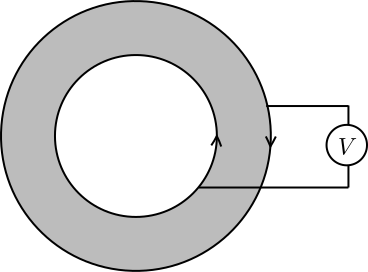
In this new drawing, we have also added arrows to indicate that we now know that each edge of the Corbino supports one chiral state. We cannot resist the temptation of showing you another beautiful plot of the local density of states, showing edge states in the Corbino geometry:
Note how the local density of states for each edge state oscillates between maxima and minima. This is because the edge state wave functions are standing waves which go all around the Corbino disk.
But back to the point. We want to consider the case when the system is in equilibrium, and we ask what are the currents that flow in the system as a consequence of the small applied voltage \(V\).
First, \(V\) does not determine the presence of a current between the edges. Even though electrons can be injected in the edges, these are separated by the bulk of the system, where due to the position of the Fermi level there are no states available to carry a current. Furthermore, there is no time-dependent flux being threaded through the Corbino disk, so the Laughlin pump is not in motion. Since there is no charge transfer at all in the direction parallel to the applied voltage, we have that the longitudinal conductance \(\sigma_L=0\).
However, what is the current \(I_\circlearrowleft\) flowing around the ring? Because such a current would flow orthogonally with respect to the applied voltage, it is associated with the Hall conductance, \(I_\circlearrowleft= \sigma_H V\).
Let’s first consider the case \(V=0\). The Fermi level is then the same at both edges. There are as many electrons going around the ring clockwise on the outer edge, as there are going around counterclockwise on the inner edge. In this case there is no net current flowing around the ring.
A small voltage difference \(V\) creates a small imbalance in the electron population between the edges. There will be, say, more electrons running counterclockwise on the inner edge than running clockwise on the outer edge. So we do expect a net current flowing around the ring.
Let’s compute the intensity of the current, it’s quite simple.
Every chiral edge state is a transport channel for the current. Now, the defining property of chiral edge states is that they only allow electrons to travel along the edge in one direction. Electrons have no chance to reverse their velocity, or in other words no chance to backscatter. This means that chiral edge states are perfect transport channels to carry a current, so they have the highest conductance possible. Quantum mechanics limits the maximum conductance that a single transport channel can have to the value \(G_0=e^2/h\), which is the conductance quantum you already met last week. With \(n\) of these channels, we obtain precisely
\[I_\circlearrowleft = n \,\frac{e^2}{h} V\,.\]
Thus, the relevant electromagnetic responses, namely the longitudinal and Hall conductivities \(\sigma_L=0\) and \(\sigma_H=ne^2/h\), can both be derived directly by only considering the chiral edge states.
