Instead, a completely unexpected result was measured for the first time by Klaus von Klitzing. Typical experimental data looks like this (taken from M.E. Suddards, A. Baumgartner, M. Henini and C. J. Mellor, New J. Phys. 14 083015):
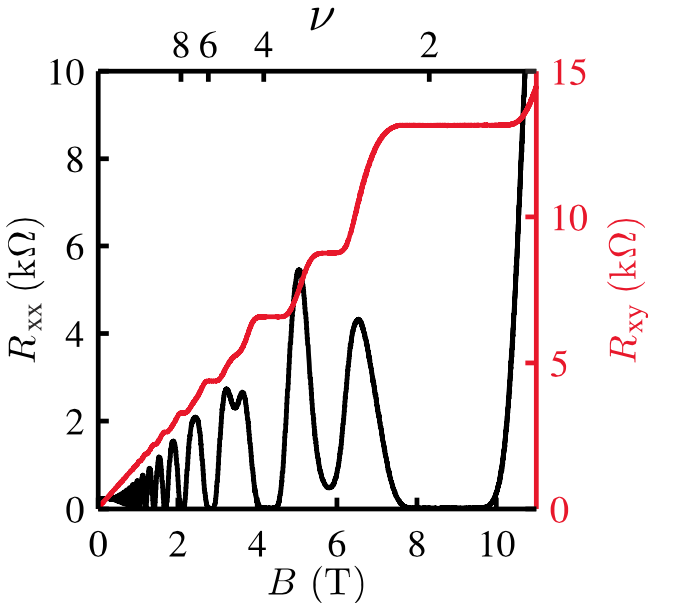
As the average density is varied, the Hall conductance \(\sigma_H\) appears to form plateaus at integer filling fractions \(\nu=1,2,3,\dots\). These plateaus are incredibly sample independent and occur at the same value in many other materials. At the same time, the longitudinal conductivity appears to vanish except at the transition points between the plateaus. This is the integer “Quantum Hall effect”.
This setup is easy to try to reproduce numerically, but there’s one complication:
