How do we probe the Pfaffian topological invariant of a topological superconductor directly? Last week, we introduced a thought-experiment where we probed the bulk-edge correspondence of Majorana modes by changing the sign of the hopping across a bond. The non-trivial value of the topological invariant results in a fermion parity switch as a result of the change in sign of the hopping \(t\) across the junction i.e.
\[t\rightarrow -t.\]
It turns out that the sign change in the hopping across the junction might also be obtained by introducing a magnetic flux through the superconducting ring (similar to the Aharonov-Bohm effect). The role of the special bond is now played by a Josephson junction, which is just an insulating barrier interrupting the ring, as in the following sketch:
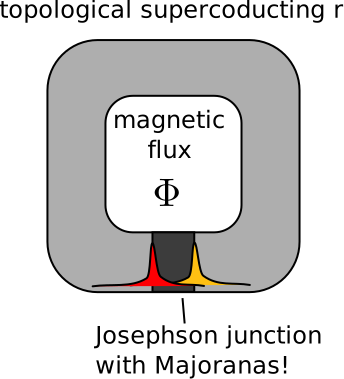
How does the magnetic flux enter the Hamiltonian? By following the usual argument for introducing magnetic fields into lattice Hamiltonians using Peierls substitution, the flux \(\Phi\) can be accounted for simply by changing the phase of the hopping across the junction in the ring:
\[t\,\to\,t\,\exp (i\phi/2).\]
Here, \(\phi = 2\pi\Phi/\Phi_0\) is usually called the superconducting phase difference across the junction, and \(\Phi_0=2e/h\) is the superconducting flux quantum. Notice that when \(\Phi=\Phi_0\) the hopping changes sign: \(t \,\to\, \exp (i\pi) t = -t\), exactly as we had last week!
Thus, the introduction of a flux quantum \(\Phi=\Phi_0\), changes the sign of the hopping \(t\rightarrow t e^{i\phi}=-t\), which as discussed last week changes the fermion parity of the ground state for topological superconductors. This fermion parity switch is related to a pair of Majorana modes coupled at the junction (as in the figure above).
To see how this happens explicitly, let’s look at the spectrum of a topological superconducting ring as a function of flux, obtained using our nanowire model:
