We have worked hard to create topological models so far. The FQH system, which is the most topological in some sense, was also more obscure in terms of microscopics. Here, we follow Alexei Kitaev and write down a simple Hamiltonian that is obviously topological, but also relatively easy to analyse.
Let’s consider a system of localized spin\(-1/2\) electrons that live on the bonds of a square lattice. The particular Hamiltonian that Kitaev wrote down is:
\[H=-A_v\sum_{+}\prod_+ \sigma_z-B_p\sum_{\Box}\prod_{\Box} \sigma_x.\]
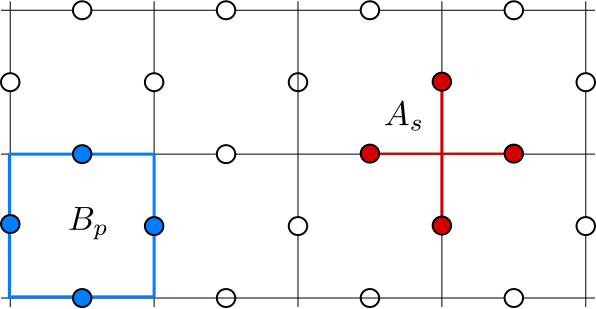
As you can see in the figure below, \(\Box\) refers to the spins on the bonds that surround a plaquette and \(+\) refers to the bonds that surround a vertex. The beauty of this Hamiltonian is that all the terms commute between themselves. The only terms that you might suspect not to commute are a plaquette term and a vertex term that share some bonds. But you can convince yourself easily (by looking at the figure) that such terms always share an even number of spins. This means that the commutation picks up an even number of minus signs and so these terms commute as well.
Since \(H\) is a sum of commuting terms, we can calculate the ground state as the simultaneous ground state for all the terms. Let us first look at the vertex terms proportional to \(A\). If we draw a red line through each bond with a spin pointing downwards (\(\sigma_z=-1\)) on our lattice (as shown below), then we find that each vertex in the ground state configuration has an even number of red lines coming in. Thus, we can think of the red lines forming loops that can never be open ended. This allows us to view the ground state of the toric code as a loop gas.
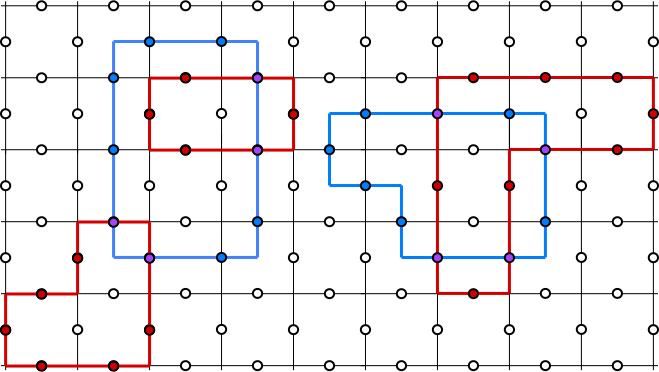
What if we focus on the large plaquette term limit i.e. \(A_v\ll B_p\) instead? The toric code is fairly symmetric between the vertex and plaquette terms. Clearly, focusing on the \(\sigma_z\) diagonal basis was a choice. If we draw loops (blue lines) through the dual lattice (whose vertices are in the middle of the original lattice) whenever \(\sigma_x=-1\) on some link. This results in a loop gas picture (blue lines) on the dual lattice, which focusses on the \(\sigma_x\) terms.
Returning to the \(\sigma_z\) representation, it looks like every loop configuration is a ground state wave-function and so is a massively degenerate loop space \(L\). But this conclusion doesn’t include the plaquette terms (i.e. the \(B_p\) coefficient) yet. Since the plaquette terms commute with the vertex terms in the Hamiltonian, the plaquette terms take us between different loop configurations. Considering the plaquette Hamiltonian in the low energy space of closed loops we can show that the ground state wave-function must be the sum of all possible (i.e. ones that can be reached by applying the plaquette terms) loop configurations with equal weight.
The ground state looks pretty non-degenerate at this point but if we consider the system with periodic boundary conditions - namely on a torus, we immediately see that there are 4 topologically distinct loop configurations that are degenerate. Basically, the plaquette terms can only deform the loops smoothly and therefore cannot change the parity of the winding numbers of the loops.
It is however possible to continuously deform a closed loop into a pair of loops along some cycle of the torus. So only the parity of the loop winding across a cut cannot be changed. Thus, the toric code on a torus has 4 degenerate ground state wave-functions (all with the same energy), which are topologically distinct. The difference between these wave functions is the parity of the number of loops crossing a vertical or a horizontal cycle on the torus.
Does this have anything to do with the way we have defined topology in this course, using the bulk-edge correspondence? Unfortunately and confusingly, not. These interacting systems are topological in the sense of having a topological degeneracy between topologically distinct states that cannot be continuously deformed into one another. In a sense, this is a more amazing feature than the bulk edge correspondence itself - the degeneracy between these states cannot be lifted by any reasonable (local) perturbation. This is sort of similar to Majorana fermions, but even more robust. In fact, the toric code does not even have edge states, so there is really no bulk-edge correspondence to speak of.
The topological robustness makes the topologically degenerate states particularly attractive to store quantum information. The main challenge of quantum information is the quantum decoherence problem, where local fluctuations in the Hamiltonian destroy the phase coherence of the quantum system used to store information. The solution proposed by topological quantum computation is to use the topologically degenerate space of a toric code to store the information. In fact, this is in essence what is being attempted by experimentalists who work on superconducting qubits, under the framework of the surface code.