First of all, greetings from the TOPOCMx team! We are very happy that you chose to follow our course.
Through TOPOCMx we want to provide an introduction to the new topics on topology in condensed matter. We want it to be simple, and we want it to be useful for people with very different background and motivation.
We want the course to be useful to you if you are a master student, and you want to get an understanding of what topology is all about.
Or you could be a PhD student or a postdoc doing experiments, and you want to get a better theoretical understanding of what you should expect in your investigations.
You could even be a theorist working in topology and be extremely familiar with topological invariants and vector bundles, but you would like to get a better understanding of how the mathematical ideas apply in physical systems.
Finally, we also want this course to be equally useful if you are, say, a professor working in condensed matter and you want to apply the ideas introduced by topology in your domain, so that you just need a quick overview of what research activity is there.
But even despite your different backgrounds, we want our course to feel like this:
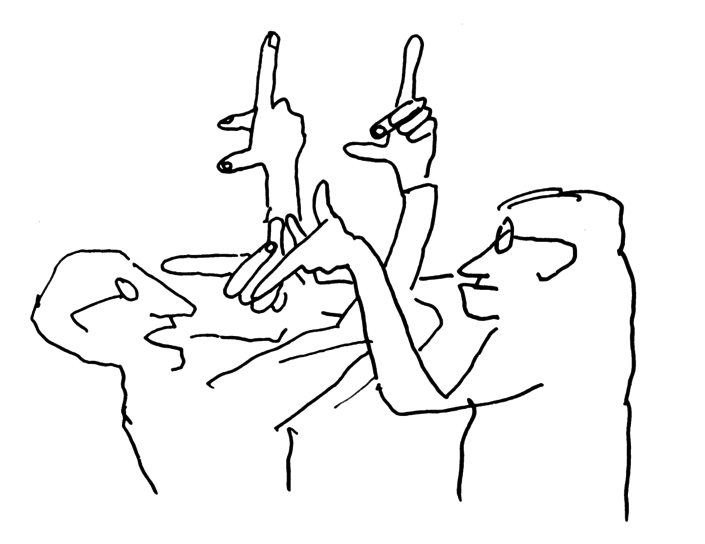
rather than this:
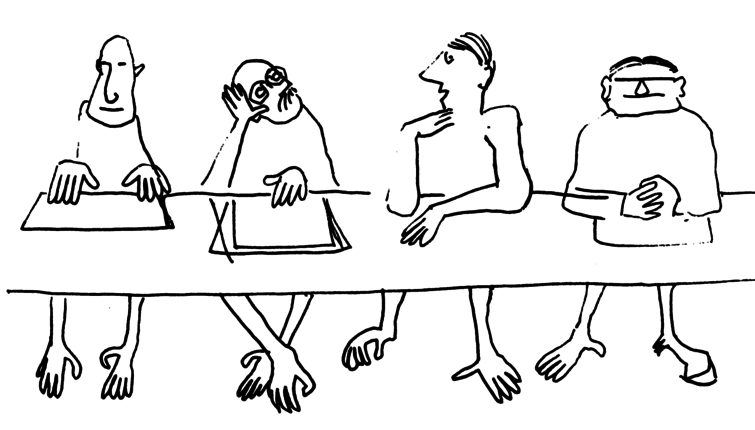
(Images by Bruno Touschek, © 1981 CERN CC-BY-3.0)
What you get
Let us explain what you can expect from the course, and what is special about it. The first thing which you need to understand is that the course is hard. We don’t mean advanced and involved math (we took care to skip all the parts that don’t help understanding). Instead, since topology has impact on many different physical phenomena, the course will touch a lot of different concepts in condensed matter physics.
First of all, we will provide you with a description of the most important facts and discoveries in topology in the most simple and concise manner that we can find.
This will still be hard to some of you, since the required background in condensed matter physics is still broad. If you see that it is the case, you will need to search for advice in the course discussions, so you’ll also use the course as an expert community.
If you are experienced already, you may find the lectures straightforward. However, even though active research on topological insulators began less than ten years ago, the field is already incredibly broad.
This is why we want our course to also fulfill a role of a journal club: every week we’ll ask you to read one of several suggested papers, observe how the concepts that you learn appear in a new context, and summarize it for the other participants. That way you will learn to analyze research papers and get an overview of the field.
Most of the numerical simulations that are used in our research are actually amazingly easy if you know how to do them. While teaching how to do computer simulations is not our main aim, we provide already set up simulations for the systems we describe in the lectures.
Using these computer simulations you can see for yourself how various models behave, discover new parameter regimes that we don’t cover in the lectures, or even extend the simulations and see how adding new terms to the models changes the results.
How you can help us
MOOCs like this one are not a usual way for providing graduate-level materials, and even less so materials that are a topic of active research.
We believe that it is a very useful and promising way of knowledge dissemination, that has advantages over a book, a university course, or a review.
This is why it is extremely important for us to know what is your background and your motivation to take the course. We want you to share what you found difficult, what you found easy, and where you think the course can be improved.
Moreover, we publish the source code for every single bit of this course in this Github repository. So whenever you see a typo, or you would like to suggest an improvement, you can open a new issue, (or even make a pull request if you know how to use Github).